
· fitness · 10 min read
Home Bodyweight Plan for Beginners
A no-equipment starter week for beginners: six scalable moves, a simple schedule, and streak tactics that keep you showing up.
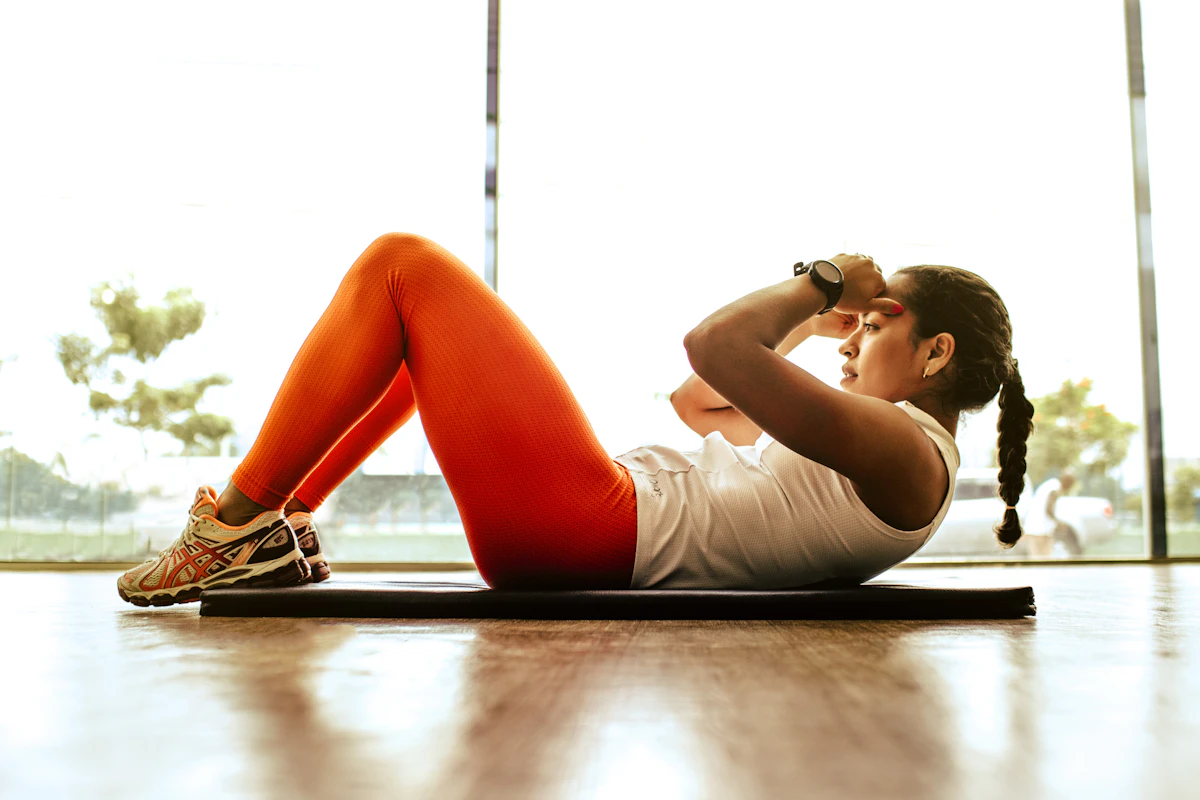
You do not need a gym membership, a dumbbell rack, or a spare room to start training. A small patch of living-room floor and your own body weight are enough for a genuine strength stimulus in your first weeks. This plan gives you six scalable moves, a three-day starter week, and a streak system that makes showing up feel like progress instead of chores.
Why bodyweight training is enough to start
Short answer: your muscles respond to tension and progression, not to iron. Health authorities recommend at least 150 minutes of moderate-intensity activity per week plus muscle-strengthening work that covers the major muscle groups, and they stress that any amount of activity beats none12. Two full-body sessions a week already check the strengthening box for a beginner2.
The lab evidence backs this up. In one four-week trial, healthy men training push-up progressions three days per week gained upper-body strength comparable to a bench-press group, with larger gains on the push-up progression test itself3. A separate eight-week study matched push-up load to 40% of bench-press one-rep max and found similar growth in the chest and triceps plus similar strength gains in both groups4. The mechanism is progressive overload: more reps, harder variations, and slower tempos over time. That is exactly what this plan automates for you.
What you need before day one
Almost nothing. Clear a space roughly the size of a yoga mat, keep water nearby, and wear shoes or go barefoot on a non-slip surface. A sturdy chair or countertop covers incline push-ups, and a wall handles warm-ups and balance support. Each session takes 20 to 30 minutes including warm-up and cooldown.
Warm up for about five minutes every session: march in place, arm circles, leg swings, and a slow set of bodyweight squats to rehearse the pattern. A proper warm-up rehearses the exact joints and ranges you are about to load, which is covered in more depth in this warm-up guide. Stop any exercise that causes sharp joint pain, and see a clinician before starting if you have a heart condition, uncontrolled blood pressure, or an injury that limits movement.
The six starter moves and how to scale each
These six patterns cover your legs, glutes, chest, shoulders, back stabilizers, and trunk. The golden rule: pick the hardest variation you can perform with clean form for the full rep target, and only level up when every rep looks crisp. Quality reps build strength; sloppy reps build frustration.
Incline push-up: wall, counter, knees, floor
Stand arm’s length from a wall, hands flat at chest height, body in one straight line from head to heels. Bend the elbows to bring your chest toward the wall, then press back. When 3 sets of 12 feel easy with a one-second pause at the bottom, move to a countertop, then a sturdy table, then knees on the floor, then full push-ups. Keep ribs tucked and hips level — no sagging lower back, no craning the neck. Open with 2 to 3 sets of 6 to 10 reps.
Bodyweight squat: assisted, free, tempo
Stand with feet roughly shoulder-width apart, toes turned slightly out. Push your hips back and bend your knees, keeping your chest up and heels planted, until your thighs reach about parallel to the floor. Hold a doorframe or chair for balance at first, then go unassisted, then add a three-second lowering phase. Your knees should track over your toes rather than collapsing inward. Aim for 2 to 3 sets of 8 to 12 reps.
Glute bridge: double-leg, march, single-leg
Lie on your back with knees bent and feet flat, arms resting at your sides. Squeeze your glutes and lift your hips until knees, hips, and shoulders form a straight line, then lower slowly. Too easy? Alternate lifting each foot a few inches (marching) while hips stay level, then progress to full single-leg bridges. This move wakes up glutes weakened by long sitting hours. Work through 2 to 3 sets of 10 to 15 reps.
Reverse lunge: supported, free, walking
Stand tall, step one foot back about two feet, and lower until both knees bend near ninety degrees. Push through the front heel to return. Many beginners find reverse lunges friendlier than forward lunges because balance is easier and knee stress often feels lower. Hold a wall or chair early on, then go unsupported, then try alternating walking lunges across the room. Build to 2 sets of 6 to 8 reps per leg.
Dead bug: bent-knee, extended
Lie on your back, arms pointing at the ceiling, hips and knees bent at ninety degrees. Brace your midsection and press your lower back gently into the floor. Slowly lower your right arm overhead while extending your left leg, return, and switch sides. Beginners should keep the working knee bent; extend the leg fully only once your back stays pinned down. This trains trunk stability without the neck strain crunches cause. Try 2 sets of 6 to 8 slow reps per side.
Knee plank: short holds, full plank, taps
From hands and knees, walk your knees back so head, hips, and knees align, and hold while breathing steadily. Begin with two or three holds of 15 to 20 seconds. Move to a full plank on your toes, then to alternating shoulder taps for an anti-rotation challenge. Quit the set when your hips sag or your lower back aches — a shorter perfect hold beats a long sloppy one every time.
Your first-week schedule
Train three non-consecutive days, for example Monday, Wednesday, and Friday. Every session follows the same template while your body learns the patterns:
- Warm-up: 5 minutes of easy marching, arm circles, leg swings, and one slow rehearsal set of squats and wall push-ups.
- Main circuit: perform the six moves in order, resting 45 to 60 seconds between exercises. Beginners do one full round in session one, two rounds in session two, and two to three rounds in session three.
- Cooldown: 3 to 5 minutes of easy walking around the room plus gentle stretching for quads, chest, and hamstrings.
On rest days, take a 10 to 20 minute walk or do light mobility work rather than sitting all day. Walking counts toward the weekly activity total and speeds recovery by keeping blood flowing to sore muscles. If a session feels crushing, cut one round instead of skipping outright — a short workout preserves your streak and your habit. Tiny sessions still compound, which is the whole thesis behind small daily habits.
Expect mild muscle soreness one to two days after the first sessions. That dull, symmetrical ache is normal and fades as your body adapts. Sharp, one-sided, or joint-centered pain is not normal: regress the variation, check your form, and get assessed if it persists.
How to progress in weeks two through four
Progression is the training effect. Follow this ladder in order, and only climb one rung at a time:
- Add reps. When you hit the top of a rep range with clean form across all sets, add one or two reps per set next session.
- Add a round. Once three rounds of the circuit feel manageable, that becomes your new standard session.
- Harden the variation. Drop the incline on push-ups, remove the chair from lunges, or extend the dead bug further. Then restart at the bottom of the rep range.
A concrete example: week one incline push-ups at the counter for 3 sets of 8 becomes 3 sets of 12 by week three, so week four moves to a lower table at 3 sets of 6 to 8. Repeat this cycle per move on its own timeline — your squat may advance faster than your push-up, and that is completely normal.
After four consistent weeks, add a fourth weekly session or lengthen holds and tempos before hunting for new exercises. Most beginners stall not from easy exercises but from never making easy exercises harder. Track reps, variations, and rounds in a notebook or an app so each session has a target to beat.
Gamify your streaks so you keep showing up
Motivation gets you to day one; systems get you to day ninety. Turning sessions into a game with points, levels, and streaks is more than a gimmick: a meta-analysis of 16 randomized trials with over 2,400 participants found gamified activity programs produced a small-to-moderate activity increase, and they outperformed equivalent non-game programs5. The trick is designing rules that reward consistency rather than perfection.
Start with a streak definition you can actually defend. A perfect week means three sessions, not seven — rest days are part of the program, not breaks from it. Mark each completed session with an X on a calendar and protect the chain with one rule: never miss twice. One skipped day is life; two in a row is a new habit forming in the wrong direction.
Layer on quests the way games do. Assign yourself a weekly quest (finish all three circuits), a form quest (film one set of squats and check depth), and a bonus side quest (a ten-minute walk on two rest days). Completing all three unlocks a small real-world reward you choose in advance: a favorite meal, a movie night, or new workout socks. This quest structure mirrors what makes fitness games sticky, as explored in this breakdown of turning lifts into quests.
Social accountability multiplies the effect. Tell one friend your weekly target, join a challenge, or compare streaks on a leaderboard — public commitments are harder to abandon quietly. If you want the full treatment at home, these ideas combine well with the tactics in the home-workout gamification guide.
A tracker like Workout Quest fits naturally here since it is free to start: log each bodyweight session, earn XP and achievements for completed workouts, work through daily and weekly quests, and compare streaks with friends on the leaderboard. The exercise library includes GIF demonstrations for checking form, and AI-driven workout plans (a premium feature) plus recovery analysis are there when they outgrow the starter phase.
Mistakes that stall beginners
Most home-training failures come from the same short list. Skipping the warm-up to save five minutes trades away the joint preparation that keeps shoulders and knees happy. Chasing reps with collapsing form — knees caving in squats, sagging hips in planks — trains faulty patterns that plateau early. Going all-out on day one produces crippling soreness that kills day three; leave two reps in reserve during week one. Program-hopping every few days prevents the repeated exposure your nervous system needs to master each pattern. And comparing your week one to someone’s year three ignores the only comparison that matters: last week’s version of you.
The bottom line
Three weekly sessions, six scalable moves, one rung of progression at a time, and a streak system that rewards showing up. That formula carries a beginner from couch to consistent in a single month without spending anything. Set up your space tonight, run session one tomorrow, and let the chain of X’s do the motivating from there.
Footnotes
-
World Health Organization. Physical activity fact sheet, 2026. https://www.who.int/news-room/fact-sheets/detail/physical-activity ↩
-
Centers for Disease Control and Prevention. Adult Activity Guidelines. https://www.cdc.gov/physical-activity-basics/guidelines/adults.html ↩ ↩2
-
Kotarsky CJ et al. Effect of Progressive Calisthenic Push-up Training on Muscle Strength and Thickness. Journal of Strength and Conditioning Research, 2018. https://pubmed.ncbi.nlm.nih.gov/29466268/ ↩
-
Kikuchi N, Nakazato K. Low-load bench press and push-up induce similar muscle hypertrophy and strength gain. Journal of Exercise Science and Fitness, 2017. https://pmc.ncbi.nlm.nih.gov/articles/PMC5812864/ ↩
-
Mazeas A et al. Evaluating the Effectiveness of Gamification on Physical Activity: Systematic Review and Meta-analysis of Randomized Controlled Trials. Journal of Medical Internet Research, 2022. https://pmc.ncbi.nlm.nih.gov/articles/PMC8767479/ ↩